
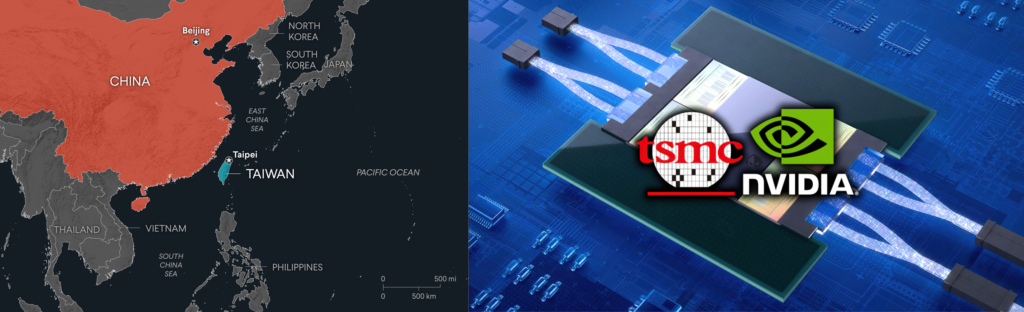
In recent years, Taiwan has moved beyond traditional military preparedness and adopted a broader strategy known as “Whole-of-Society Defence.” This approach reflects a deeper reality that modern conflicts are no longer limited to battlefields; they involve economies, technology, and entire societies. Taiwan’s case is particularly significant because its security is closely linked with global technology supply chains and great power competition.
Taiwan is a small island located just about 180 km from mainland China, yet its global importance is enormous. The reason lies in semiconductor technology. Taiwan produces a dominant share of the world’s advanced chips, which are essential for smartphones, laptops, automobiles, and artificial intelligence systems. The Taiwan Semiconductor Manufacturing Company (TSMC) plays a central role in this ecosystem, manufacturing a large portion of the world’s most advanced semiconductors. In simple terms, control over chips increasingly means control over modern technology.
China considers Taiwan as part of its territory and has repeatedly asserted its claim over the island. In recent times, it has increased military exercises near Taiwan, along with the deployment of fighter jets and warships. This reflects China’s long-term objective of reunification. However, Taiwan functions as a self-governing democratic entity, which creates a major geopolitical dispute and a sensitive flashpoint in international relations.
The broader global context makes the situation even more complex. The United States is engaged in multiple geopolitical tensions, conflicts in different regions are affecting global energy markets, NATO appears divided on several issues, and international institutions often seem ineffective in resolving crises. This fragmented global environment creates strategic opportunities for rising powers and increases uncertainty in regions like the Indo-Pacific.
In response to these challenges, Taiwan has adopted a Whole-of-Society Defence strategy. This approach goes beyond conventional military strength and includes civilian preparedness, protection of critical infrastructure, cybersecurity readiness, and coordination between government, military, and citizens. The core idea is that defence is not limited to armed forces; it is a collective responsibility of the entire society.
The strategic logic behind this model is clear. Taiwan understands that in the event of a conflict, it may face a stronger military power. Therefore, instead of relying only on conventional warfare, it focuses on resilience, continuity of systems, and increasing the cost of any potential aggression. This reflects the broader concept of asymmetric warfare, where relatively weaker actors adopt innovative strategies to counter stronger adversaries.
Taiwan’s importance is also deeply connected to global economic security. Major companies across the world depend on Taiwanese semiconductor production. Any disruption in Taiwan would affect global supply chains, create economic instability, and impact industries ranging from technology to automobiles. This makes Taiwan not just a regional issue, but a matter of global concern.
Looking ahead, multiple scenarios are possible. These include direct military confrontation, economic and technological pressure, or attempts to influence Taiwan’s internal politics. China may not rely solely on military action; it could also use indirect methods such as economic leverage and political influence to achieve its objectives.
For UPSC and MPSC aspirants, this topic is highly relevant. It is important for understanding China–Taiwan relations, the role of the United States in the Indo-Pacific region, the significance of semiconductor supply chains, and the changing nature of warfare. It can also be effectively used in essay topics related to technology, power, and global order.
In conclusion, Taiwan represents a new phase in global geopolitics where technology, economy, and security are deeply interconnected. The concept of Whole-of-Society Defence highlights that in modern conflicts, survival depends not only on military strength but also on the resilience and preparedness of an entire nation.
Political Science by Shahaji Sir
Powered by Shikshavalli