
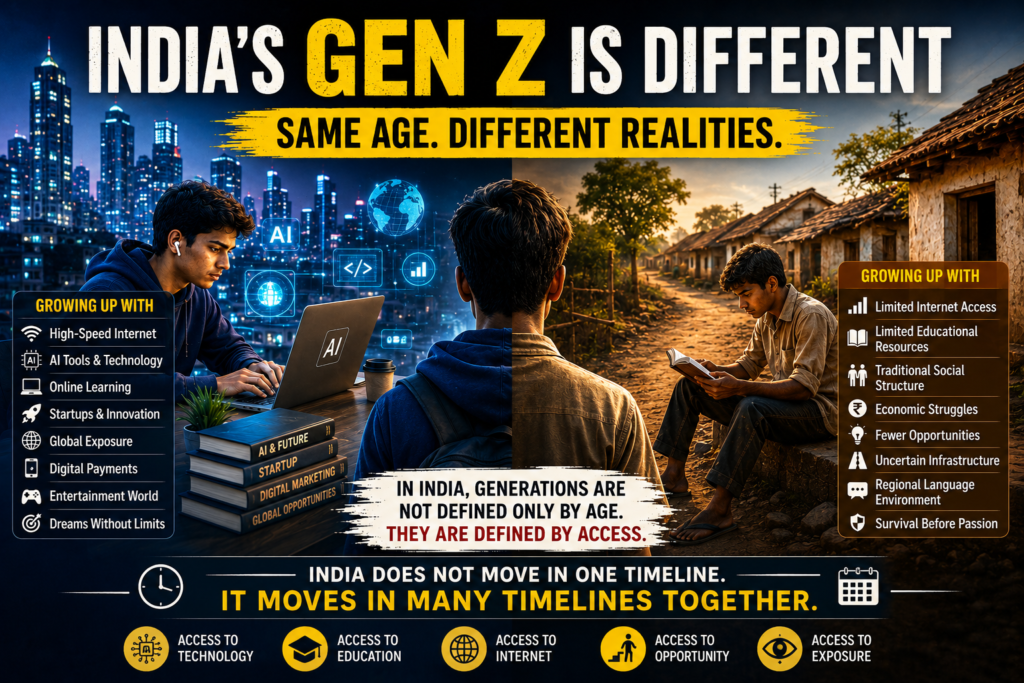
The World Talks About Generations — But Does India Fit the Formula?
For the last few years, the world has become obsessed with generation labels. Everywhere we hear terms like Millennials, Gen Z, Gen Alpha, and now even Gen Beta. Social media experts, marketing companies, educators, and psychologists constantly discuss how each generation thinks, behaves, learns, spends money, or builds relationships.
Gen Z is often described as the “digital generation.” They are seen as internet-first individuals who grew up with smartphones, social media, and instant global connectivity. But while these global discussions may fit many developed countries, one important question remains unanswered: Can one generation formula truly explain India?
Perhaps not.
Because India is not a society moving in one single timeline. It is a country where multiple realities coexist simultaneously.
Two Children Born in the Same Year, Yet Living in Different Worlds
Imagine two children born on the same day in 2026. One is born in Mumbai, while the other is born in a remote village in Bihar, Maharashtra, or West Bengal. Technically, according to demographic definitions, both belong to Generation Beta. However, their lived experiences may be completely different.
The child growing up in Mumbai may enter a world filled with artificial intelligence tools, smart classrooms, high-speed internet, online learning platforms, global entertainment, and career aspirations shaped by technology and globalization. By the age of fifteen, such a student may already be discussing coding, freelancing, content creation, startups, or international opportunities.
On the other hand, the child growing up in an underdeveloped rural region may face an entirely different reality. Limited internet access, lack of educational infrastructure, traditional social structures, and economic struggles may shape his or her worldview far more strongly than global digital culture. In many places, students are still struggling for stable electricity, quality schools, career guidance, or even basic digital exposure.
Both children are born in the same year. Yet psychologically, socially, and technologically, they may belong to different eras altogether.
Why Western Generation Theories Cannot Fully Explain India
This is where Western generation theories fail to fully capture the Indian experience.In many developed nations, social and technological changes spread relatively uniformly across society. But India develops unevenly. Some regions experience the future earlier, while others are still trying to fully enter the present. As a result, age alone cannot define an Indian generation.
A 20-year-old student in Bengaluru may think like a global digital citizen, while another 20-year-old from a rural background may still live within social conditions that resemble urban India from the late 1990s or early 2000s. The difference here is not intelligence or capability; it is exposure.
In India, Access Shapes Generations More Than Age
In India, generations are not shaped only by birth years. They are shaped by access — access to technology, education, internet connectivity, language, economic opportunities, and urban exposure.
This is why applying a single “Gen Z” identity to all Indian youth creates an oversimplified picture of reality. India’s youth population is far too diverse to fit neatly into one global category.
The digital habits, ambitions, and lifestyles of urban students may look very similar to global Gen Z culture. At the same time, millions of young Indians continue to experience life through completely different social and economic conditions.
India Is Living in Many Timelines at Once
Perhaps India is one of the few countries where multiple generations coexist at the same time within the same national boundary. One India is rapidly adapting to artificial intelligence and global digital culture, while another India is still fighting for basic developmental access.
And maybe that is the most important truth about Indian youth today: India does not move in one timeline. It moves in many timelines together.
Political Science By Shahaji Sir