
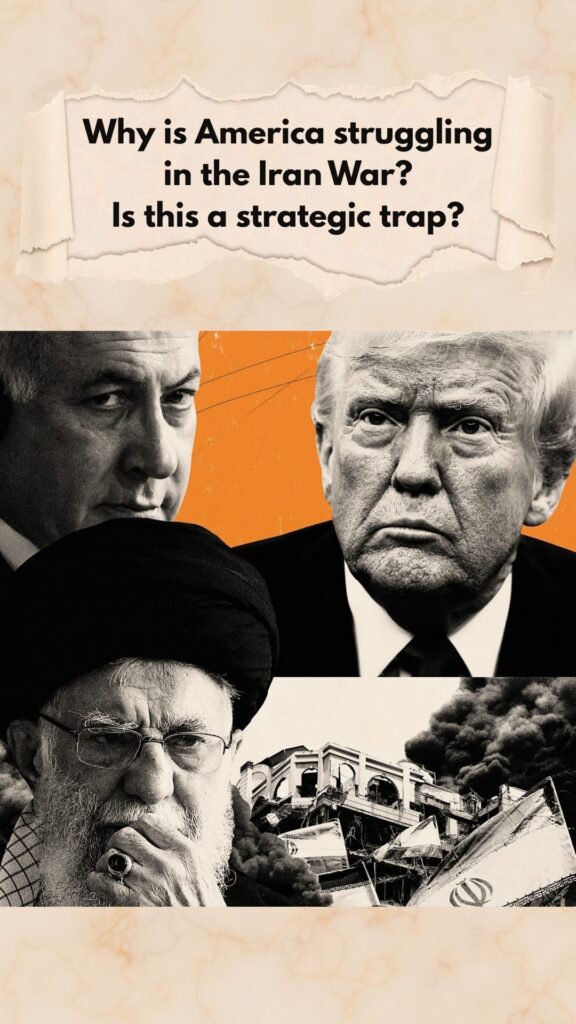
INTRODUCTION
War today is not just about bombs and borders.
It is also about alliances, contradictions, and strategic traps.
The ongoing Iran conflict shows something unusual:
👉 The United States, the most powerful country in the world, is now seeking help from the same allies it once criticized.
This raises a key question:
Has America trapped itself in a war it cannot easily control?
1. HOW THE U.S. ENTERED THE TRAP
The conflict escalated after U.S. support for Israeli actions against Iran.
Initially, this appeared as a show of strength.
But soon, the situation changed:
- Iran responded by targeting global oil routes
- The Strait of Hormuz was disrupted
- Oil prices surged globally
👉 This shifted the war from military conflict → global economic crisis
Now the U.S. is not just fighting Iran,
It is managing global economic instability.
2. IRAN’S STRATEGY: INDIRECT PRESSURE
Iran did not confront the U.S. directly.
Instead, it used:
- Strategic geography
- Control over chokepoints
- Asymmetric warfare
Result:
👉 The cost of war increased for the U.S. without direct confrontation
This is a classic strategic trap:
You enter easily, but exiting becomes costly.
3. TRUMP’S CONTRADICTION
This is where your blog becomes very powerful 👇
Earlier, Donald Trump repeatedly argued:
- NATO members are “free riders”
- The U.S. carries unfair burden
- Allies “use America”
But now, in this war:
👉 Trump is asking NATO and global allies for help
- He pressured European countries to send forces
- Warned NATO of a “very bad future” if they refuse
- Criticized allies for not supporting operations
At the same time:
👉 He also said “maybe we shouldn’t even be there”
This shows a deep strategic inconsistency.
4. NATO’S RESPONSE: REFUSAL AND DISTANCE
Most NATO countries have refused to participate:
- Germany clearly said: no mandate, no involvement
- UK, France, others are cautious
- Many countries demand clarity before joining
👉 Important point:
This war is NOT a NATO war
So allies are treating it as:
👉 “America’s war, not our obligation”
5. THE REAL PROBLEM FOR THE U.S.
Now the U.S. faces a difficult situation:
- It cannot easily escalate (risk of wider war)
- It cannot easily withdraw (loss of credibility)
- Allies are not fully supporting
- Global economy is under stress
👉 This is the definition of a strategic trap
6. ISRAEL FACTOR
Another important layer:
- The conflict was triggered in context of Israel–Iran tensions
- U.S. support for Israel pulled it deeper into the conflict
👉 This creates a perception:
America is fighting not just for itself,
but also for regional alliances
This complicates global support.
7. BIGGER GEOPOLITICAL SHIFT
This situation reflects a larger change:
- Decline of unquestioned U.S. leadership
- Rise of strategic autonomy among allies
- Movement towards a multipolar world
Even allies are now asking:
👉 “Why should we fight America’s war?”
FINAL ANALYSIS
REAL ISSUE → Not just war, but credibility and alliances
The U.S. is facing three simultaneous pressures:
- Military pressure from Iran
- Economic pressure from global disruption
- Diplomatic pressure from reluctant allies
CONCLUSION
This war reveals a critical truth of modern geopolitics:
👉 Power is not just about strength
👉 It is about consistency, alliances, and strategy
The United States is not weak.
But it is strategically constrained.
And sometimes, a superpower is not defeated on the battlefield…
It is trapped by its own decisions.
Political Science by Shahaji Sir
Powered by Shikshavalli